

Foundational
Microsoft 365 Governance
Opinion
When Something Becomes a Pattern
A perspective on how repeated local decisions gradually become structural patterns — and why recognising that shift matters for governance.
Introduction
Not everything that repeats is recognised as a pattern.
In most Microsoft 365 environments, repetition begins informally — a workaround reused, a structure copied, a decision repeated because it worked once.
These choices are rarely documented.
They are rarely questioned.
They simply continue.
Over time, repetition accumulates.
What appears incidental begins to take on structure — quietly, but with impact.
Repetition Is the Earliest Form of Structure
Teams rarely begin with governance.
They begin with delivery — responding to immediate needs and moving work forward without pausing to define structure.
As similar situations arise, those decisions are reused. Not because they are defined standards, but because they worked before. Over time, this reuse introduces consistency.
They begin with delivery.
A site is created.
A library is structured.
Permissions are assigned.
When similar needs arise, the same decisions are reused:
“Let’s follow what we did last time”
“Use the same structure as the previous project”
“Copy that permission model”
At this stage, the intention is efficiency — not governance.
But repetition introduces consistency.
And consistency, even when unplanned, is the beginning of structure.
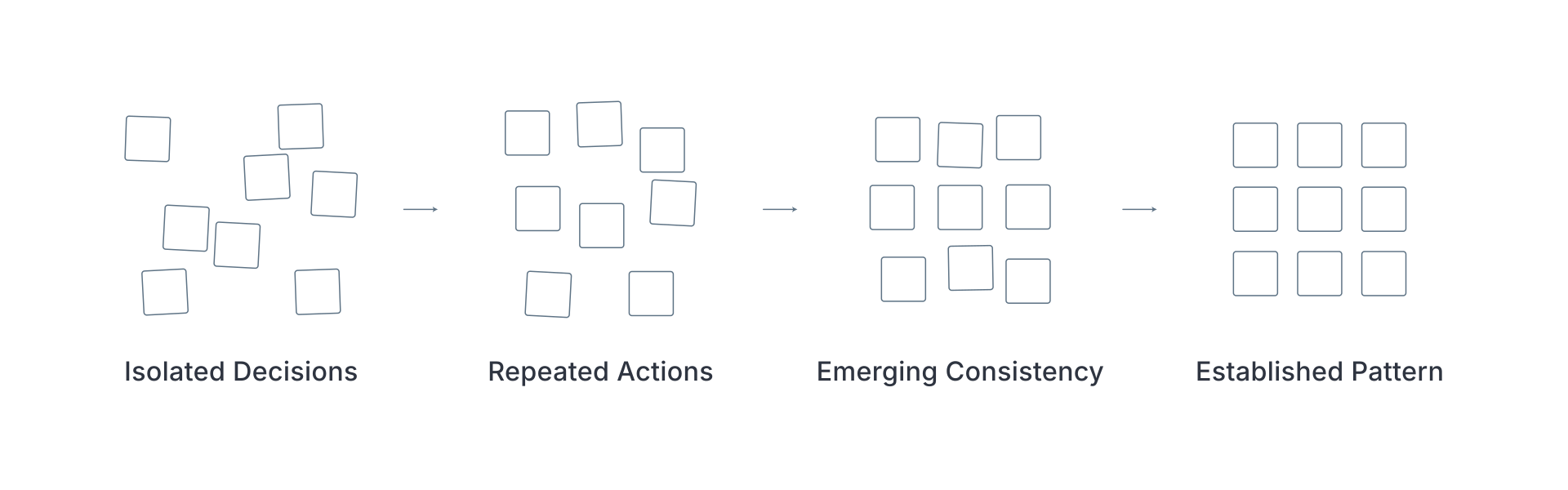
When Something Becomes a Pattern
When Repetition Becomes a Pattern
A pattern is not defined by how often something is repeated.
It is defined by reliance. When teams begin to depend on earlier decisions, repetition shifts from convenience to expectation. What was once optional becomes the default.
Repetition becomes a pattern when:
- Teams expect it to be followed
- Deviations create confusion
- New work depends on earlier decisions
- The structure begins to influence behaviour
At this point, the environment is no longer just being used.
It is starting to shape how work happens.
Patterns Often Remain Unseen
Most patterns are not formally recognised.
They remain in use without being defined. Over time, they begin to influence how information is organised, accessed, and understood — even though no one has explicitly designed them.
Folder structures start to carry meaning.
Permission models begin to define authority.
Naming conventions affect how easily information can be found.
These are no longer small decisions.
They are structural elements — even if no one has named them as such.
Informal Patterns Do Not Scale
What works within a team does not extend across the organisation.
As different teams repeat similar practices independently, variation begins to emerge. The same intent leads to different implementations, and consistency starts to break down.
Structures diverge.
Naming varies.
Permissions are applied differently.
Duplication increases.
The environment grows — but without alignment.
And without alignment, scale introduces complexity instead of efficiency.
Governance Begins with Recognition
Governance is often introduced as a corrective step.
But it begins earlier — at the point where repetition becomes structural. Recognising this shift allows action before inconsistency spreads and becomes embedded.
At this stage, the focus should be on:
- Identifying recurring practices
- Evaluating their effectiveness
- Deciding what should be standardised
- Assigning ownership
Without recognition, governance remains reactive —
and reactive governance is harder to sustain.
From Pattern to Design
Once patterns are recognised, they can be shaped.
What was informal can become intentional — defined structures, standard templates, controlled permission models, and clear conventions. This is where consistency becomes deliberate.
This transition changes the nature of the environment.
It moves from something that evolves through repetition
to something that is designed with purpose — and can be sustained over time.
Conclusion
Not all repetition needs to be formalised.
But it should be observed.
Because the point at which something becomes a pattern is also the point at which:
- Structure begins to form
- Dependence begins to grow
- Governance becomes necessary
Ignoring this shift leads to fragmentation.
Recognising it allows structure to be defined — before inconsistency takes hold.